


Best Countries To Move to From Canada (And How To Get There)
September 2, 2026
Even though Canada is often cited as one of the best countries to live in, a growing number of Canadians are choosing to emigrate. The reasons vary, ranging from the country’s real estate shortage and higher prices to long waiting times for specialist medical treatments. For high-net-worth individuals, high taxes are an important driver for leaving Canada.
In this article, we’ll examine some of the best countries to move to from Canada. You’ll learn what the top choices are, what they have to offer to Canadian emigrants, and how to establish residence in those countries.
How To Choose the Best Country To Immigrate to From Canada

When choosing the best country to move to from Canada, here are some of the criteria you should consider:
- Cost of living: Housing, groceries, and everyday expenses are especially important factors if moving on a fixed income
- Access to high-quality healthcare: Quality of care, local insurance, and access to public healthcare are significant concerns for retirees or anyone with ongoing medical needs
- Tax treatment: Countries with tax regimes that don’t subject foreign-sourced income to taxation are beneficial for high-earners, retirees, and Canadian business-owners
- Weather: While some people want to relocate to a country with a completely different climate, others simply want to avoid Canada’s harsh winters
- Ease of obtaining residence: Countries can have specific pathways suited for different expat profiles, including investor visas, programs for digital nomads, or retiree residency schemes
Professional advisors can help you explore your options when choosing the country to move to from Canada. They can assist in examining the benefits and drawbacks of specific destinations and help you make an informed decision.
9 Best Expat Countries for Canadians

The nine best countries you can relocate to from Canada include:
- Portugal
- Mexico
- Ireland
- Costa Rica
- Panama
- New Zealand
- Greece
- Australia
- Switzerland
1. Portugal
Portugal is a suitable destination for Canadians looking to trade snow for mild, Mediterranean-style winters. The country also experiences more hours of sunshine than Canada, and the Atlantic coastline offers year-round access to the sea.
Additional reasons Canadians might be interested in moving to Portugal include:
- Slower, family-oriented lifestyle
- Cost of living that is 21% lower than in Canada
- EU-wide mobility with Portuguese residence
Portugal levies taxes on worldwide income for resident individuals and companies, while non-residents are liable for taxes only on their Portugal-derived income.
The tax rates in Portugal are:
| Tax | Rate |
| Personal income (tax resident) | 12.5%–48% |
| Personal income (non-resident) | 25% |
| Corporate income | 19% (14.7% plus potential surcharges in Azores and 14.7% with no surcharges in Madeira) |
| Capital gains | Up to 24% for real estate and 28% for movable assets |
Portugal offers several pathways to become a resident:
- Work visa for individuals employed in Portugal, digital nomads, independent workers, and entrepreneurs
- Passive income visa for retirees and individuals with other sources of passive income
- Startup visa for entrepreneurs working with certified incubators
- Golden Visa program for investors in culture, business, or investment funds
2. Mexico
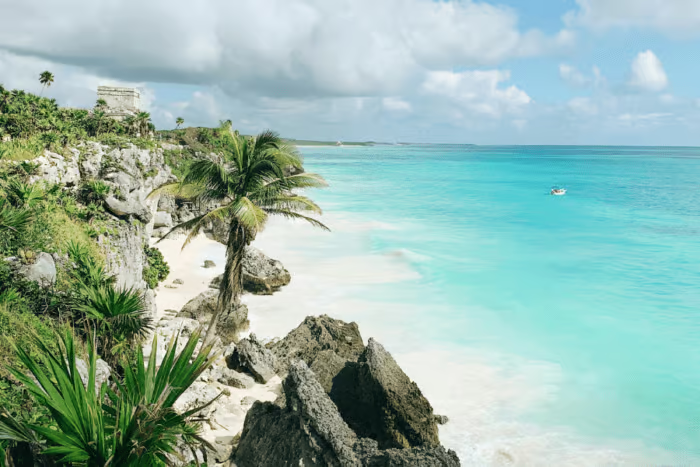
Mexico might appeal to Canadians looking for a country with a warmer climate and a lower cost of living. Mexico experiences more sunshine hours than Canada and has a higher average temperature year-round, while also offering a 32% lower cost of living.
As one of the top destinations for medical tourism in the world, Mexico also offers high-quality, affordable healthcare.
Mexico has a territorial tax system, levying a progressive tax on worldwide earnings for residents and taxing non-residents only on locally-sourced income. The rates are:
| Tax | Rate |
| Personal income (tax resident) | 1.92%–35% |
| Personal income (non-resident) | 15%–30% |
| Corporate income | 30% |
| Capital gains | 10%–35% |
Mexico offers a permanent resident visa for retirees and pensioners who meet the requirements for minimum pension income (CAD 10,832) or personal solvency through investment or savings (CAD 435,672).
You can also apply for a temporary residence permit based on:
- Economic solvency: CAD 108,894 in savings or investment of CAD 6,461 in monthly income
- Real estate ownership: Minimum real estate value of CAD 871,439
- Investment: Ownership of CAD 435,672 worth of shares in a Mexican company
Note that prices are based on current exchange rates and may fluctuate due to changes in the exchange rate between the Canadian dollar (CAD) and the Mexican peso (MXN).
3. Ireland

Ireland offers Canadians an easy transition thanks to the shared language, with the added benefit of a milder climate and easy access to the rest of Europe. Ireland is also known for its hospitable culture and friendly locals.
The country does, however, have a 23% higher cost of living than Canada, with specific expenses being much higher (rent is 41% more expensive in Ireland), and some roughly on par with Canada’s (groceries are only 1.4% more expensive).
Ireland imposes worldwide taxation on individuals who are both residents and domiciled in the country. Non-domiciled residents are liable for taxes on Ireland-sourced income, foreign employment income earned while in Ireland, and any income remitted to the country. Non-residents are liable only on income derived from Irish sources.
The tax rates in Ireland are:
| Tax | Rate |
| Personal income | 20% or 40% |
| Corporate income | 12.5% or 25% |
| Capital gains | 33% to 40%, with a possible 10% rate subject to conditions |
Following the closure of the Immigrant Investor Program (IIP) in 2023, the most accessible options for moving to Ireland are:
- Securing employment in the country and applying for a work permit
- Starting a business in Ireland and applying for the Start Up Entrepreneur Program (STEP)
- Retiring in Ireland as a person of independent means with a minimum yearly income of EUR 50,000 (CAD 80,600) and access to a sufficient lump sum for emergencies
4. Costa Rica
Costa Rica offers Canadians an overall 14% lower cost of living than Canada, with expenses such as rent being even more favorably priced in the Central American country (28% lower than in Canada).
In addition to the low cost of living, Canadians may choose to move to Costa Rica for:
- High-quality, affordable healthcare
- Warm, tropical climate
- The Pura Vida life philosophy, which focuses on wellbeing and simple joys
Costa Rica has a territorial tax system, meaning it taxes only income derived within the country. The system applies to both residents and non-residents, with the following tax rates:
| Tax | Rate |
| Personal income | 0%–25% |
| Corporate income | 5%–30% |
| Capital gains | 15% |
Costa Rica offers multiple pathways to become a temporary resident and meet requirements for permanent residence:
- By investing at least USD 150,000 (CAD 210,000) in real estate, shares, securities, or other investment vehicles in the country
- By having a source of passive income that generates at least USD 2,500 (CAD 3,500) per month
- By having a pension of at least USD 1,000 (CAD 1,400) per month
5. Panama
With its warm weather and relaxed outdoor lifestyle, Panama has attracted a large expat community, including Canadians. They are drawn to the country for its low cost of living, 27% lower than in Canada, and affordable access to high-quality healthcare.
Another major draw to Panama is its territorial tax system, which taxes both residents and non-residents only on locally-sourced income. The tax rates for Panama-sourced income are:
| Tax | Rate |
| Personal income | 0%–25% |
| Corporate income | 25% |
| Capital gains | 10% (a 3% withholding tax on the total purchase price typically applies) |
Canada is on the list of nations whose citizens are eligible for Panama’s Friendly Nations Visa program, which offers eligibility for permanent residence after a two-year provisional permit. Qualifying criteria for the program include:
- Securing employment in Panama
- Owning real estate with a minimum value of USD 200,000 (CAD 280,000)
- Making a three-year fixed-term deposit of at least USD 200,000 (CAD 280,000) with a local bank
Panama also has a fast-track Qualified Investor Visa program, as well as separate programs for individuals of independent means and pensioners.
6. New Zealand
New Zealand and Canada are both Commonwealth nations with similar values and a common language, making it easier for Canadian expats to settle in. New Zealand has a milder climate than Canada and is often noted for a better work-life balance and access to outdoor activities.
New Zealand offers an overall comparable cost of living to Canada. Some types of expenses are noticeably more affordable, including rent, which is 13% lower than in Canada. However, real estate in New Zealand can be 21% more expensive.
New Zealand taxes residents on worldwide income and non-residents on locally-sourced income. However, subject to certain conditions, new tax residents may benefit from a temporary exemption on most types of foreign-sourced income for 48 months. The tax rates are:
| Tax | Rate |
| Personal income | 10.5%–39% |
| Corporate income | 28% |
| Capital gains | No comprehensive law; some forms are treated as income |
The pathway to becoming a New Zealand permanent resident usually starts with obtaining temporary residence through one of the following pathways:
- Skilled worker or Green List job pathways for skill- and employment-based residence
- Active Investor Plus Visa, which requires a NZD 5 million (CAD 4.12 million) or NZD 10 million (CAD 8.24 million) investment in funds, bonds, or philanthropy
- Business Investor Visa, which requires a NZD 1 million (CAD 824,000) or NZD 2 million (CAD 1.65 million) investment in a business
7. Greece
Island hopping, Mediterranean climate, and an incredible historical wealth are among the main reasons for Canadian expats to consider moving to Greece. The country also has a significantly lower cost of living than Canada, up to 26%, and offers mobility across the EU.
Greece taxes its permanent residents on their worldwide income. However, eligible individuals who transfer their tax residence to Greece may opt for a special lump-sum tax regime under which foreign-source income is generally subject to a fixed annual tax of EUR 100,000, regardless of the amount of foreign income. The tax rates are:
| Tax | Rate |
| Personal income | 9%–44% |
| Personal income from real estate | 15%–45% |
| Corporate income | 22% |
| Capital gains | 15% |
Greece’s Golden Visa program offers several pathways to secure indefinite residence in the country after making one of the eligible investments:
- Real estate investment, starting at EUR 250,000 (CAD 403,000)
- Investment in government bonds, shares, or qualifying mutual funds, starting at EUR 350,000 (CAD 564,000)
- Company formation with a minimum investment of EUR 500,000 (CAD 806,000)
- Startup investment of at least EUR 250,000 (CAD 403,000)
Greece also issues a residence permit to non-EU nationals who can demonstrate an income of EUR 3,500 (CAD 5,600) to support themselves in the country.
8. Australia
Australia is home to some of the most liveable cities in the world, and it offers a year-round outdoor lifestyle that may appeal to some Canadians. Both countries are members of the Commonwealth, and the shared language makes it easier for Canadians to adjust to life in Australia.
While the quality of life is slightly better in Australia than in Canada, it comes with a higher cost of living. Rent is 15% higher in Australia, while grocery prices are almost 20% higher on average.
The country taxes its residents on their worldwide income, while non-residents are liable only for taxes on Australia-sourced income and certain capital gains. The rates are:
| Tax | Rate |
| Personal income | 15%–45% |
| Personal income (non-residents) | 30%–45% |
| Corporate income | 30% (25% for SMBs) |
| Capital gains | Subject to the PIT rate |
Australia has recently undergone significant changes to its visa program, removing streams for retirees, business owners, and investors.
The point-based Skilled Independent Visa remains a viable choice for Canadian professionals, while the National Innovation Visa has emerged as an option for Canadians who can secure an invitation to apply from Australia’s Department of Home Affairs.
9. Switzerland
Widely considered one of the best countries in the world for high-net-worth individuals, Switzerland is often cited as one of the few tax havens in Europe.
While the country levies a personal income tax at the federal, cantonal, and municipal levels, it also allows new residents without a Swiss source of income to enter into a lump-sum agreement with cantons. The lump-sum system taxes expenditure rather than income, usually producing a significantly lower tax bill.
Switzerland also offers:
- High-quality healthcare
- Well-developed private banking sector
- Exceptional political stability and security
- High purchasing power
An important factor to take into account when considering Switzerland is its high cost of living. Canadians can expect to spend more in Switzerland in most expense categories, including:
| Expense Category | Cost Difference |
| Groceries | 54% |
| Rent | 61% |
| Utilities | 82% |
| Restaurants | 73% |
Permanent residence permits in Switzerland are issued by cantonal immigration authorities. They typically recognize residence without gainful employment as a separate pathway for high-net-worth individuals and retirees.
What To Consider When Leaving Canada
In addition to the logistics of moving to a different country, leaving Canada also comes with some practical and financial considerations worth planning for:
- When you stop being a resident in Canada for tax purposes, you can become liable for an exit tax called a deemed disposition, which treats your assets as if they are sold and creates tax liabilities on gains
- The rules for using your registered retirement savings plan (RRSP) and tax-free savings account (TFSA) change when you leave Canada, incurring withholding tax liabilities or monthly penalties for contributions
- Countries with strong public healthcare systems may require a minimum residency period for expats before they are eligible for treatment, creating a coverage gap that can be bridged with private healthcare
In addition to these factors, you should know that obtaining residency in a foreign country can be challenging and time-consuming, even in countries with streamlined procedures.
Working with specialist advisory firms can help you navigate the process without incurring additional costs and experiencing delays. For assistance with obtaining a residence abroad, contact Nomad Capitalist.
Move to a New Home Country With Nomad Capitalist
Nomad Capitalist is a consulting company that specializes in global mobility and wealth preservation. We’ve helped more than 1,500 clients protect their assets and lead an international lifestyle by obtaining a second residency, legally reducing tax exposure, and exploring investment opportunities abroad.
For clients who need comprehensive strategic planning and assistance with execution, we offer our Action Plan service. We create Plans in close cooperation with our clients, ensuring that every Plan is based on their current situation and long-term objectives.
Here’s what partnering with Nomad Capitalist looks like:
- We ask you to fill out a form to help us determine whether we’re a good match
- We schedule a 45-minute onboarding call to learn more about your circumstances and desires
- Our agents create an Action Plan and present it to you for approval
- We implement the Plan over a 12-month period
- You continue receiving support from us even after the Plan is implemented
If you want to acquire a second residence or citizenship and move from Canada, Nomad Capitalist can assist you in every stage of the process. We can help you examine potential destinations, making sure that every implication of the second residency is assessed.
Once you decide on the country, our agents can assist you in obtaining residency there. If your strategic goal is to become a citizen of another country, we can help you meet the requirements in the shortest possible timeline.

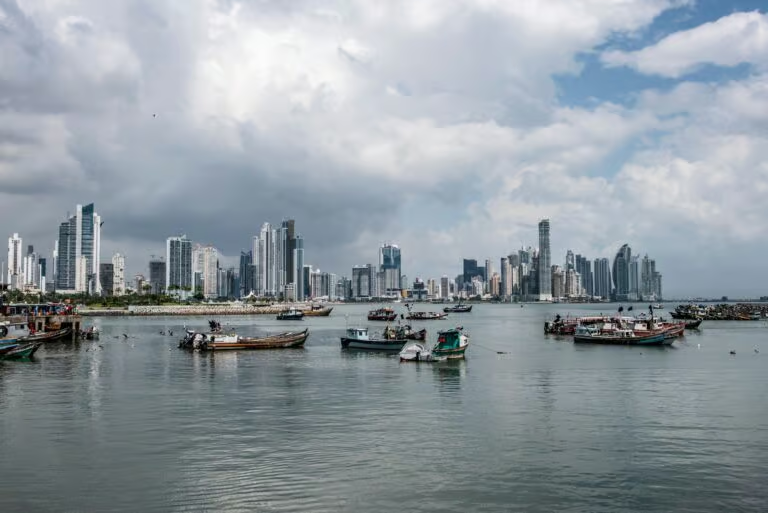
The Ultimate Guide to Panama Expat Communities: Where To Live & How To Relocate
Panama is considered one of the best countries for expats, often ranking first in surveys that examine factors like the cost of living, healthcare, and safety. The number of expats in the country is measured in hundreds of thousands, and they inhabit communities across both big cities and small towns. In this article, we’ll examine […]
Read more

Expat Life in Turkey: How To Relocate and What To Expect
With one foot in the West and one in the East, Turkey boasts a unique position as a bridge between economies, cultures, and global political spheres. This, alongside the country’s high quality of life and low cost of living, makes it a popular option for expats across all walks of life seeking a change of […]
Read more

Moving to Spain from the US: A Guide for Americans
Why do Americans move to Spain? Is it the walkable cities packed with culture? Is it the low cost of living? Is it the access to the rest of Europe at your fingertips? Or is it the food and wine? An estimated 50,000 US citizens now live in Spain. For many, the chance to leave […]
Read more