


- Home
- Articles
- Global Citizen
- MERCOSUR Residence Agreement: Member Countries, Requirements, and Rights
MERCOSUR Residence Agreement: Member Countries, Requirements, and Rights
March 20, 2026
South America’s historic openness to migration from Western countries has often overshadowed the regional movements on the continent. Internal migration shaped the region’s political and economic climate and provided a backdrop for the implementation of policies such as the MERCOSUR Residence Agreement.
In this guide, we’ll examine the Agreement, focusing on its provisions and the ways individual countries implement it. We’ll also discuss how non-MERCOSUR nationals can obtain citizenship in the bloc’s member countries.
What Is MERCOSUR?
The Southern Common Market, Mercado Común del Sur or MERCOSUR, is a trade bloc of South American countries. Established in 1991 by Argentina, Brazil, Paraguay, and Uruguay, its main goal was to promote democratic stability and economic development of member states. In practice, it facilitated the free movement of goods and regulated the internal movement of people among the member states.
As of 2026, every state on the continent has a relationship with the bloc, some as parties to it, and others as associated states:
| Status | States |
| States parties | Argentina, Bolivia, Brazil, Paraguay, Uruguay, Venezuela |
| Associated states | Chile, Colombia, Ecuador, Guyana, Panama, Peru, Surinam |
Note that Venezuela’s membership in the bloc is suspended, together with its rights and obligations.
What Is the MERCOSUR Residence Agreement?
In 2002, the states parties to MERCOSUR at the time, as well as Bolivia and Chile, signed the Agreement on Internal Migration Regularization of the Citizens of MERCOSUR, Bolivia, and Chile. Peru, Ecuador, and Colombia have since signed the Agreement as well.
Now commonly referred to as the MERCOSUR Residence Agreement, this document stipulates some of the rights citizens of MERCOSUR have in other countries of the bloc, and sets forth the procedures for exercising them.
According to the Agreement, a citizen of one member of MERCOSUR can apply for a two-year temporary residency in another member state by having to prove only:
- Their identity
- Their nationality as a citizen of MERCOSUR
- A lack of a criminal record
Members and associates of MERCOSUR don’t have to ask citizens of other MERCOSUR countries for proof of employment or economic self-sufficiency, nor for any documents showing the reason for entering the country.
Once granted temporary residency, MERCOSUR citizens can enjoy most of the rights that the host country’s citizens have, particularly in the civil, cultural, social, and economic areas. Residents can legally work, set up their own businesses, invest in their host countries, and send remittances home.
The Agreement also charts a path to permanent residency for MERCOSUR temporary residents. They can apply for permanent residency within 90 days before the temporary residency expires. The application should include proof of source of livelihood, identification and immigration documents, and records of past behavior.
MERCOSUR Residency in Practice
While the MERCOSUR Residence Agreement provides a structure for regulating temporary and permanent residence within the bloc, individual countries can still set their own procedures and requirements, as long as they don’t conflict with the Agreement.
Here’s what the MERCOUR residency application process looks like in the countries that adopted it:
- Argentina
- Brazil
- Paraguay
- Uruguay
- Chile
- Colombia
- Ecuador
- Peru
- Bolivia
Argentina
For the purposes of granting temporary residence, Argentina observes a distinction between MERCOSUR citizens by birth and naturalized MERCOSUR citizens. The country allows citizens by birth from all parties and associates to MERCOSUR, including Venezuela, to apply.
Naturalized citizens are eligible to apply if they:
- Have spent five years in the adopted home country
- Are not citizens of Surinam, Guyana, or Venezuela
The application process starts online, by submitting the following documents to the country’s RaDEx system:
- Proof of identity, which can be a passport or any other MERCOSUR-recognized document
- A certificate attesting to no convictions or pending criminal proceedings, issued by the countries where the applicant resided for more than 12 months in the past three years
- Proof of address
The RaDEx system will automatically check for criminal records in Argentina. If all the conditions for granting temporary residence are met, the applicant receives an email with an appointment date to continue the application process in person at the National Directorate of Migration.
Applications for permanent residence are treated as a change of category and require the same documents as for the original temporary residence application. Additionally, applicants also need to:
- Be able to sustain themselves financially in the country
- Spend at least half of the temporary residency in Argentina
- Not extend their stay outside of the country for longer than six consecutive months
Brazil
Brazil’s MERCOSUR temporary residence is open to citizens of signatories to the Agreement: Argentina, Bolivia, Chile, Colombia, Ecuador, Paraguay, Peru, and Uruguay. The application is processed by the Federal Police. The applicants are required to submit:
- An application form, available online
- A passport, an identity card, or a nationality certificate
- A birth certificate and proof of civil status, including proof of naturalization when applicable
- A certificate proving no judicial, criminal, or police records from the country of residence in the last five years
- A declaration of no international criminal or police records
- A certificate proving no judicial, criminal, or police records in Brazil
- The proof of fee payments
- One recent photo of the applicant (3cm x 4cm)
When applying for permanent residence, the applicant doesn’t need to submit a birth certificate or a criminal or police certificate from the previous country of residence. They do have to provide the other documents that were part of the temporary residence application, as well as:
- Proof of legal means to support themselves and their family
- National Immigration Registry Card or Certificate of Temporary Residence
Paraguay
Paraguay allows residence to citizens of the MERCOSUR Residence Agreement signatories. When applying for temporary residence, they have to provide:
- An identity card, passport, or any other national identification document
- A birth certificate from the home country
- A certificate of no police or criminal record
- A current foreigner background certificate issued by the Department of Informatics of Paraguay’s National Police
- A certificate of civil status, such as a marriage, divorce, or a spouse’s death certificate
- An affidavit of no international criminal background
- Proof of legal entry into the country
All documents, except the affidavit, should be provided in both original and authenticated copies.
For the permanent residence application, the required documents include:
- An identification document (passport, ID card, national identification document)
- A MERCOSUR Temporary Admission Card
- A current foreigner background certificate
- A document proving economic solvency (employment contract, ownership over agricultural land, tax returns, proof of company shares)
Uruguay
Citizens of parties and associates to MERCOSUR can apply for a temporary residence in Uruguay by providing:
- A passport-style photo of themselves
- A current identity document
- A criminal record certificate from the countries they resided in for more than six months in the last five years
- A birth certificate or a certificate of naturalization showing more than five years of citizenship
- A vaccination certificate
- An occupational health card, issued by a healthcare provider authorized by the Ministry of Public Health
The application process starts online by submitting the documents in PDF format on Uruguay’s official government website. It continues in person with the National Directorate of Migration.
Permanent residence applicants undergo the same procedure by submitting the same documents, except for their birth certificates or occupational health cards.
Chile
Chile issues temporary residence permits under the MERCOSUR Residence Agreement only to citizens of the original MERCOSUR signatories: Argentina, Bolivia, Brazil, Paraguay, and Uruguay. The required documents include:
- A valid passport, except for citizens of Bolivia, who can apply with their national ID
- A criminal record certificate from the countries of residence in the past five years
- A recent photo of the applicant
The application must be submitted from outside Chile through the National Migration Service’s Digital Procedure Portal.
Chile doesn’t have a separate permanent residence category for temporary residents from MERCOSUR countries who are still eligible to apply under the regular programs. If they choose the proof-of-livelihood route, applicants can prove their eligibility by demonstrating they:
- Are employed or self-employed
- Generate income by renting property
- Are retired and have a pension
- Are a merchant or a business owner
Colombia
Colombia offers temporary residence permits to citizens of the MERCOSUR Residence Agreement signatories. Applicants for the Migrant Visa M need to provide the following documents:
- An application letter detailing the activity they’ll be carrying out in Colombia and their plan to support themselves
- A valid passport
- A certificate of judicial, criminal, or police record from the countries of residence for the last three years
- An image of the entry stamp in Colombia
Colombia doesn’t have a dedicated permanent residence visa for MERCOSUR migrants. However, they can apply for the regular permanent residence visa, Visa R, after two years of temporary residence instead of the usual five. The application should contain:
- Copies of the visas and safe-conduct permits held during residency
- A certificate of migratory movements, issued by the Special Administrative Unit for Migration in Colombia
- An application letter detailing the applicant’s means of self-support and the evidence of meeting the original residency conditions
- A copy of an identity card
The applicant’s compliance with Social Security obligations might be verified during the application review process.
Ecuador
Citizens of signatory countries of the MERCOSUR Residence Agreement are eligible to apply for Ecuador’s temporary residence permit. The documents they need to provide include:
- An application form
- A 5cm x 5cm passport-style photo
- A valid passport
- A criminal record certificate for the past five years, issued within 180 days before the applicant’s last entry into the country
- A proof of means of support
When applying for permanent residence, applicants should present the same documents, with two exceptions:
- They should provide an Ecuadorian certificate of criminal record
- They can include their certificate of temporary residence, but are not required to
The residence permit is issued by Ecuador’s diplomatic missions or consular offices abroad, and by Zonal Directorates at home.
Peru
The citizens of countries that signed the MERCOSUR Residence Agreement can obtain residence in Peru under the Agreement’s guidelines. To apply for a temporary residence permit, applicants need to provide:
- An application form, available online on the Peruvian state’s official digital platform
- Proof of processing fee payment
- A copy of a passport, identity card, or certificate of nationality
- A birth certificate, a marriage certificate, and a certificate of naturalization, if applicable
- A criminal record certificate from the country of origin or residence for the past five years
- An affidavit to a lack of a criminal or judicial record in Peru and abroad
When applying for permanent residence, applicants should submit an immigration quality change form, a copy of an identity document, an affidavit stating a lack of judicial or police record in Peru, and one of the following documents as proof of livelihood:
- Employment contract
- Annual income statement
- Last six pay slips
Bolivia
Bolivia offers residency under the MERCOSUR Residence Agreement through procedures administered by the Dirección General de Migración (DIGEMIG). Nationals of MERCOSUR member and associated states can apply for:
- Temporary residence (up to two years)
- Permanent residence after holding the temporary residence for at least two years
Note: Bolivian procedures are officially recognised, but publicly available guidance is more limited than for other MERCOSUR countries. Consulting local authorities or partnering with a consulting firm is advised.
How To Get MERCOSUR Citizenship as a Foreigner
Expats looking to secure citizenship in one of the MERCOSUR countries cannot rely on the Residency Agreement for two reasons:
- It only applies to citizens of MERCOSUR countries, not residents
- It only provides a pathway to temporary and permanent residence, leaving each country to regulate its citizenship procedures and requirements autonomously
To get citizenship and benefit from the Residency Agreement, foreign nationals have to abide by a MERCOSUR country’s individual laws and processes. Typically, this includes establishing grounds for a residence permit, either by finding employment or making an investment in the country.
Securing citizenship in a foreign country requires long-term planning, regulatory compliance, and coordination across multiple legal systems. To navigate the process efficiently and minimize risks of delays or rejections, partner with Nomad Capitalist.
Secure Your MERCOSUR Residence Status With Nomad Capitalist
Nomad Capitalist is an advisory company focusing on wealth protection and global mobility. We’ve helped over 1,500 clients reduce their tax footprint, find new investment opportunities, and enjoy a more fulfilling lifestyle as residents or citizens of a foreign country.
We create an Action Plan with custom solutions for every client’s specific circumstances. The Plan is a step-by-step playbook outlining the necessary actions to help our clients achieve their financial or lifestyle goals most effectively.
Here’s what the process entails:
- We ask you to fill out a form to help us determine whether our services are a good fit for your situation
- We schedule a 45-minute onboarding call to learn more about your specific circumstances and objectives
- Our team develops an Action Plan for reaching your objectives and presents it to you for approval
- We start implementing the Plan, and we continue over the next 12 months
- You continue receiving lifelong support, even after the Plan was implemented
If you’re looking for the easiest way to access the MERCOSUR area and enjoy the benefits of the Residence Agreement, we can help. We’ll determine which country is the best fit for acquiring citizenship, guide you through the process, and handle all the administrative details until you’re ready to become a MERCOSUR citizen.


Cambodia Visa Guide [2026]: Types, Requirements, and Application Process
Millions of visitors come to Cambodia every year, attracted by its diverse ecosystems, rich history, and rapidly growing economy. The country, highly dependent on tourism and eager to attract foreign investment, has implemented a visa system that balances regulatory control with ease of access, ensuring a traveler-friendly entry process. In this article, we’ll examine the […]
Read more
Panama Work Visa: Types, Requirements, and Application Process Explained
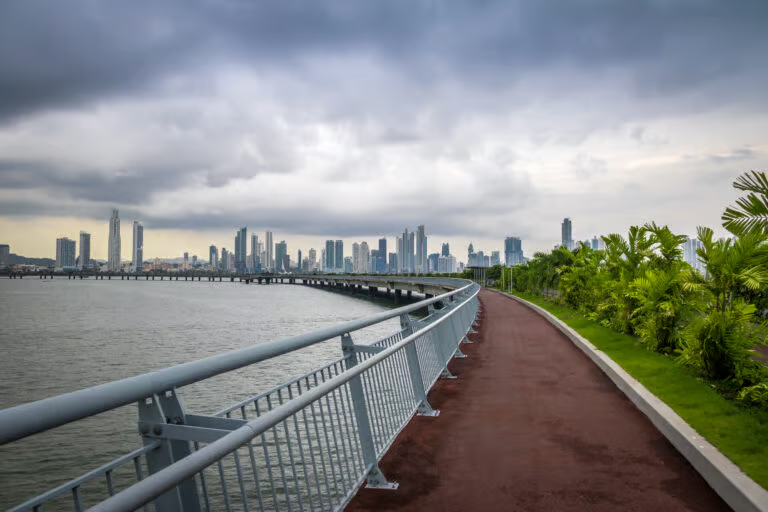
As one of Central America’s fastest-growing economies, Panama attracts professionals and skilled workers from around the world. Many seek opportunities with multinational companies, special economic zones, and the knowledge sector, while others relocate as digital nomads to benefit from Panama’s territorial taxation policy. If you’re planning to work in the country, understanding the Panama work […]
Read more

Paraguay Compared to Uruguay: Residence, Citizenship, and Expat Benefits Compared
Paraguay and Uruguay are two South American states popular among expats who are seeking a strategic Plan B residency outside the world’s primary geopolitical power centers. While both offer stability and relative seclusion, their legal frameworks, tax regimes, and lifestyle environments make them attractive to distinct types of applicants. In this article, we’ll show you […]
Read more