


Best Country To Buy Gold: Where Gold Is Cheapest in 2026
September 2, 2026
Seen as a store of value since antiquity, gold has retained its status as a safe-haven asset even as economies modernize and currencies fluctuate. Today, the price of gold is largely set globally, though local market variations and other factors can make some places better options for buyers.
In this article, we’ll help you choose the best country to buy gold. You’ll learn:
- Why gold prices differ from one country to another
- Which markets are best for purchasing gold
- How to go about purchasing gold abroad
Is the Gold Price Different in Different Countries?
The price of gold can vary between countries, and the differences are influenced by multiple factors.
To understand how gold prices might change from one country to another, it’s important to understand how the price is formed:
- The global spot price sets the baseline
- Exchange rates set the local gold prices
- Local market and policy factors determine the final price
The Global Spot Price Sets the Baseline
The global markets set the baseline price of gold. This baseline, known as the spot price, is administered twice daily under the London Bullion Market Association’s (LBMA) benchmark. The spot price reflects real-time trading between major buyers and sellers, such as banks, refineries, and institutional buyers.
The spot price is quoted in U.S. dollars and is the same everywhere in the world.
While the spot price is influenced by supply and demand, it also has a special relationship with the value of the dollar. A stronger dollar often reflects greater confidence in the U.S. economy, making gold less attractive to hold. As capital flows out of gold, its price goes down.
A weaker dollar has the opposite effect: confidence in the dollar declines, prompting investors to move funds into gold as a hedge. The influx of capital into gold drives up its price. Whatever the price ends up being, it’s identical across the world at this stage.
Exchange Rates Set the Local Gold Prices
Since the baseline price is quoted in U.S. dollars, it has to be converted into local currency before it reaches domestic markets. This will influence the price of gold locally, depending on the local currency’s strength against the dollar:
- A weaker local currency will make gold effectively more expensive in that country
- A stronger local currency will make gold less expensive
These adjustments happen without any changes to the spot price.
Local Market Factors Determine the Final Price
Once the spot price is converted locally, local markets apply their own additional costs. These costs are set by government policy and can be in the form of import duties, which are tariffs levied on gold entering the country, plus sales tax or value-added tax.
In addition to these costs, gold sellers will add their own premium, which may consist of:
- Fabrication costs: Bullion tends to have standardized minting costs, while jewelry pricing depends on the crafting cost of specific pieces
- Distribution and dealer margin: These constitute the seller’s markup
- Demand-driven markup: Premiums that rise during times of high local demand or in high-demand markets
All of these costs compound to create the price charged to the end buyer.
Best Countries To Buy Gold in 2026
Countries on our list offer a perfect combination of low-tax environments and markets with competitive pricing, making them the cheapest countries to buy gold.
The top countries for buying gold include:
- United Arab Emirates/Dubai
- Hong Kong
- Switzerland
- Singapore
- Thailand
United Arab Emirates/Dubai

Dubai is the heart of the gold trade in the UAE. It’s the home of the Dubai Gold Souk, an internationally famous gold market with hundreds of dealers and a wide selection of gold jewelry, as well as coins and bars.
The Dubai Multi Commodities Center (DMCC) is also located in Dubai. Set up as a free zone, it hosts infrastructure such as vaults, refineries, and jewelry manufacturing facilities, and it also runs the Dubai Gold and Commodities Exchange (DGCX).
Dubai has two different VAT treatments of gold products, depending on whether it’s investment gold (minimum purity of 99% and minted in a form tradeable on bullion markets) or any other kind of gold:
| Form of Gold | VAT/Sales Tax |
| Investment | 0% |
| Jewelry or lower purity gold | 5% (standard VAT) |
In addition to low tax rates and a large offer, Dubai is a good place to buy gold due to the following reasons:
- VAT recovery: Non-residents of Dubai may recover the VAT when taking the gold out of the country
- Good Delivery Standard: Gold quality is backed by a federal enforcement standard, not just seller reputation
- Negotiable prices: Buyers might secure better prices if they’re willing to haggle. However, only the making charges can be negotiated down
- Gold-backed crypto: DMCC’s Tradeflow platform has pioneered gold-backed digital assets, which is an option not available on most other markets
Bonus read: Learn more about the UAE’s residence visa and Golden Visa program.
Hong Kong

As one of Asia’s foremost financial centers, Hong Kong is aiming to solidify its role as a global hub for gold trading, as well as the gateway to the exceptionally large market in China.
The city has announced a wave of improvements to its gold infrastructure, including a tenfold increase in gold storage capacity by 2030. It has also recently launched a centralized clearing system, which is expected to increase safety and further reduce gold trading costs.
Hong Kong’s status as a free port gives it a very favorable tax profile for gold buyers:
| Form of Gold | VAT/Sales Tax |
| Investment | 0% |
| Jewelry or lower purity gold | 0% |
The city also doesn’t impose capital gains tax on profits realized from gold investments.
Other factors that make Hong Kong attractive to gold buyers include:
- A modernizing exchange: The Hong Kong Gold Exchange (HKGX) relies on a century of traditional trading practices while integrating modern financial infrastructure and its own regional price benchmark
- Geographic diversification: Buyers looking for exposure to different market profiles may consider Hong Kong a good choice for storing gold
- Reputable retail chains: Several gold retail chains listed on the local stock exchange operate in Hong Kong, offering high price transparency
Switzerland

Switzerland has a well-deserved reputation as one of the world’s premier gold trading centers.
The country’s long-standing neutrality has made it a global haven for wealth preservation. Switzerland is home to some of the world’s most prestigious refineries, such as PAMP Suisse, Argor-Heraeus, and Valcambi. Multiple sources confirm that between 50% and 70% of the world’s gold is refined in the country.
Switzerland is one of the best countries to buy investment gold due to its favorable tax rates:
| Form of Gold | VAT/Sales Tax |
| Investment (99.5% purity) | 0% |
| Granules (99.5% purity) | 0% |
| Government-minted coins under specific tariffs | 0% |
| Jewelry or lower purity gold | 8.1% |
Additional reasons to purchase gold in Switzerland include:
- Trusted global documentation: Swiss gold is the global standard for purity and quality control
- Secure storage: Switzerland has many high-security, non-bank storage facilities for holding valuable assets such as gold, in addition to traditional storage options in banks
Singapore
Singapore is sometimes referred to as the Geneva of the East because it shares Switzerland’s reputation for political and economic stability, a strong rule of law, and secure wealth storage. The country has also established its place as the regional center for gold by exempting investment-grade precious metals from the Goods and Services Tax.
Like the other best countries to buy gold, Singapore has special tax treatment for investment-grade gold that’s at least 99.5% pure, cast into a shape that’s tradeable on international bullion markets, and produced by a former or current LBMA Good-Delivery-listed refinery:
| Form of Gold | VAT/Sales Tax |
| Investment | 0% |
| Jewelry or lower purity gold | 9% |
Additional reasons to purchase gold in Singapore include:
- Potential tax refunds: Foreign visitors might qualify for a partial GST refund for goods they purchased from participating sellers
- Quality backed by a national standard: Singapore’s voluntary hallmarking scheme allows sellers to certify purity through the Singapore Assay Office
- Variety of gold purities on offer: In addition to investment-grade bullion, Singapore’s sellers stock 18K and 14K gold, as well as 22K gold favored in South and South-East Asian jewelry traditions
Thailand: The Cheapest Country To Buy Gold Jewelry
Thailand presents a special case as one of the best countries to buy gold. The country’s standard for gold purity is 96.5%, and it applies to both jewelry and investment gold in smaller bars. Purchases of 96.5% gold make up the majority of gold trades in the country.
The unusual standard has two consequences:
- As investment gold, Thai gold’s distinct purity and weight system can make it harder to resell abroad compared to standard international bars
- As jewelry, Thai gold offers exceptional purity compared to what’s typically available in other markets
As a policy to protect local manufacturing, Thailand promotes relatively low labor costs for manufacturing, making it a lucrative market for buyers seeking high-purity jewelry at competitive prices.
Bonus read: Learn more about Thai visa requirements and discover how to get an investor visa.
What Buyers Should Know When Purchasing Gold Internationally
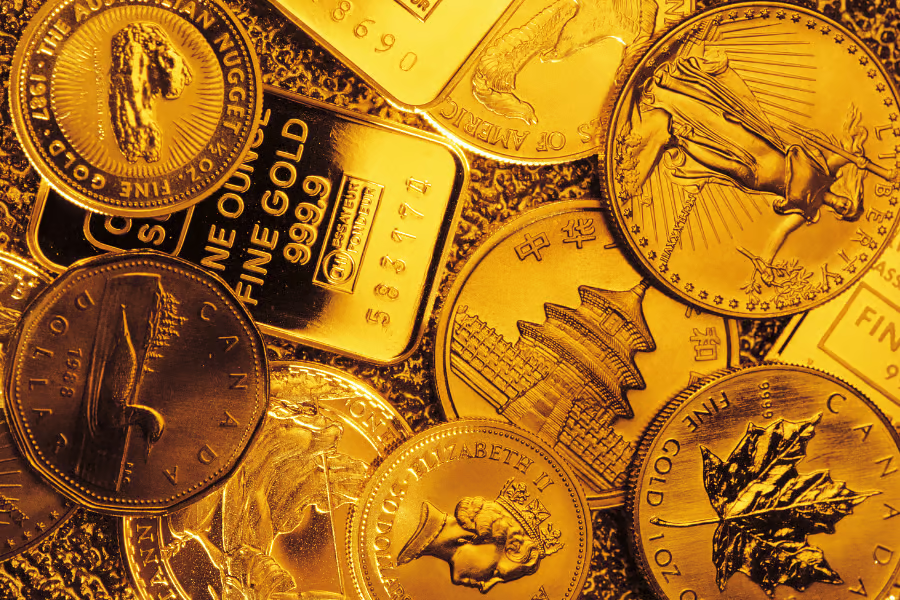
Buying gold can carry certain risks, especially in a foreign, unfamiliar country. To ensure a smooth and secure purchase experience, buyers should pay special attention to:
- Choosing a reputable dealer
- Verifying authenticity
- Arranging storage
Choosing a Reputable Dealer
The usual methods for choosing a reputable dealer include:
- Using online resources to find dealers and customer reviews
- Evaluating accreditations, licensing, or certifications to confirm a dealer is recognized by an official industry body or regulator
- Checking membership in trade associations
- Asking for proper documentation and a receipt with every purchase
Countries can have different regulatory requirements that dealers must comply with, and understanding them can help buyers assess a dealer’s reputability.
For example, gold dealers in the UK are required to display a Dealer’s Notice that highlights approved hallmarks used to verify authenticity. Even online dealers have to comply with this requirement. If they don’t, that’s a justifiable reason for concern.
Verifying Authenticity
While choosing a reputable dealer reduces the risks of buying counterfeit or misrepresented gold, it’s not a sufficient guarantee. Most buyers still rely on markings and documentation to confirm the authenticity of their purchase.
A bar should typically have three marks:
- The logo of the refinery that produced the bar
- A stamp identifying the purity of the gold
- A stamp showing the weight of the bar
Bars can also contain marks that denote the country of origin, as well as the serial number. Buyers can also verify the gold using certificates of authenticity issued by assay offices or assay certificates issued by manufacturers. Other forms of gold might have smaller marks, which is the case with jewelry.
In cases where physical testing is needed, there’s a variety of non-destructive and destructive methods to verify the purity of gold, including:
- Fire assay testing
- X-ray fluorescence testing
- Electrical resistivity testing
Arranging Storage
When choosing where to store gold internationally, banks are one of the most common options, offering safe deposit boxes or dedicated bullion storage with physical security.
However, bank storage might not be the ideal option for the following reasons:
- Deposits aren’t necessarily insured against theft or loss by default
- Regulatory compliance requirements might infringe on buyers’ privacy
- Access to deposits might be limited by the facility’s operating hours
Another option is to arrange storage with private non-bank vault facilities. They can offer advanced security features and risk insurance, along with a privacy profile that caters to clients’ varying reporting requirements. Some private storage facilities operate in freeports and designated economic zones, offering even more privacy under local laws.
As for the choice of jurisdiction, neutral countries like Switzerland or Singapore may be appropriate due to the history of stability and strong rule of law. Some investors prefer to store their gold in countries with a different political or economic profile compared to their country of origin. This strategy ensures that instability at home doesn’t affect access to assets abroad.
Gold as Part of an International Diversification Strategy
Gold is a tangible asset with a low correlation with the stock market, making it an effective diversification tool. When equities fall, gold often holds or rises. Its price has historically trended upward in the long term, and it reacts favorably to short-term market disruptions.
However, while purchasing gold is an effective alternative investment strategy for portfolio diversification, it shouldn’t serve as its sole component. Gold’s biggest downside is that it doesn’t yield any income, and its value relies entirely on price appreciation.
A well-diversified asset allocation strategy that includes gold should:
- Limit any asset’s share of the portfolio to reduce exposure in the case of downturns
- Include income-generating assets such as real estate, timber, or dividend-paying investments to balance appreciation with yield
- Spread holdings across multiple currencies and countries to limit dependence on a single economy or jurisdiction
Building a portfolio that is diversified across asset types and jurisdictions can be a complex process. It requires an understanding of foreign tax and regulatory systems, an on-the-ground knowledge of local market dynamics, and hands-on experience with cross-border transactions and logistics. For assistance with your cross-border asset diversification, contact Nomad Capitalist.
Diversify Your Assets With Nomad Capitalist
Nomad Capitalist is an advisory company that focuses on cross-border mobility and asset protection. We’ve helped more than 1,500 clients achieve their international diversification goals by obtaining second residency or citizenship, legally reducing tax exposure, and investing in assets abroad.
Our core service is the Action Plan—a step-by-step guide for achieving your financial and lifestyle objectives. We build each Plan around our clients’ unique circumstances and needs to ensure the most efficient path forward.
Here’s what partnering with Nomad Capitalist looks like:
- We ask you to fill out a form to help us determine whether we’re a good match
- We schedule a 45-minute onboarding call to learn more about your situation and desires
- Our agents create an Action Plan and present it to you for approval
- We implement the Plan over a 12-month period, managing the administrative parts
- You continue receiving lifelong support from us, even after the Plan is implemented
If you’re interested in diversifying your assets globally, Nomad Capitalist can help you identify real estate investment opportunities abroad. We can assist in choosing the best countries to invest in and advise you on jurisdictions where real estate ownership can lead to residency and, eventually, citizenship. If you decide to pursue a second residency or citizenship, we can assist you in the process of obtaining it. To find out more, contact Nomad Capitalist today!


Is Land Investment Safer?
When American humorist and writer Mark Twain said, ’Buy land, they’re not making it anymore,’ he was definitely on to something. Land is finite, and that scarcity gives it lasting appeal. Yet, despite its obvious logic, land remains one of the most misunderstood investments. Many people are put off by its perceived complexity, potential legal […]
Read more

Top Emerging Market Economies for US Investors in 2025
If you’re still parking all your capital in overvalued US real estate or clinging to tech stocks in the S&P 500, you’re playing an old game while rivals are redesigning the board. The world has move on. Smart investors know that the biggest returns aren’t coming from Wall Street anymore – they’re coming from below-the-radar […]
Read more

Monaco Real Estate Guide: Market Trends and Opportunities
When it comes to luxury real estate, nowhere does things quite like Monaco. This tiny but ultra-exclusive principality isn’t just a place to live – it’s a global symbol of wealth, prestige and financial freedom. In 2025, Monaco remains the world’s most expensive real estate market, with average property prices soaring beyond €51,000 per square metre […]
Read more